The household
The crane is the product. This is the door to the whole household.
ai-gantry is the
runtime: one Distroless Go process, one persona, one OpenAI-compat
model, memory you can sqlite3. Chat dials out.
/new distills; the person is still there on Thursday.
Health is an exit code. No open ports. Ever.
Most things branded “harness engineering” are skills and slash
commands inside a host you do not own. This stack is the host.
Gantree is the shipping yard those cranes live in — a board for an
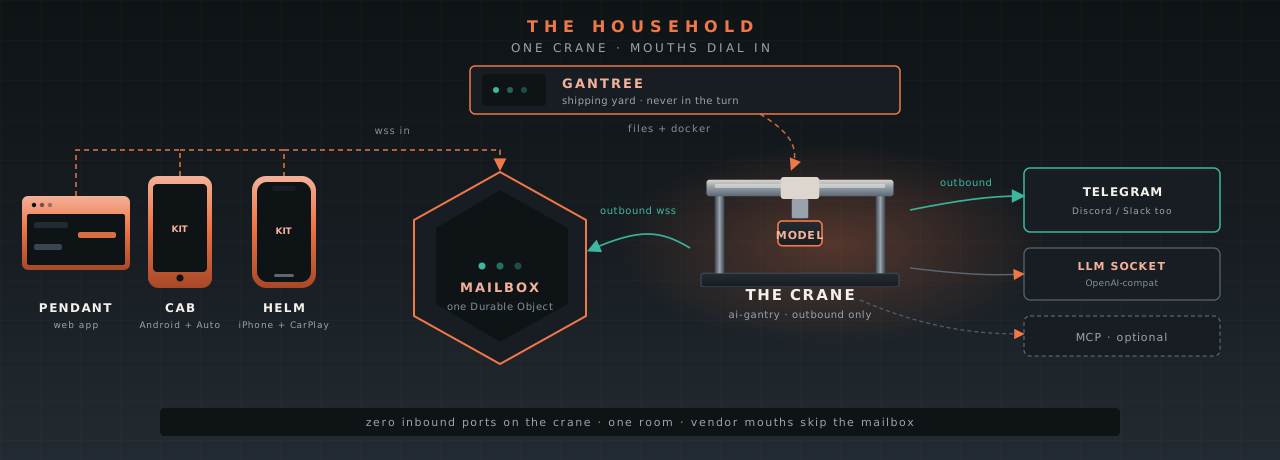
operator, never a hop in a chat turn. You talk through a mailbox we
own:
gantry-pendant
in the browser,
gantry-cab on
Android (and Android Auto),
gantry-helm on
iPhone (and CarPlay). Telegram, Discord, and Slack still work.
- gantry
- The rigid frame that holds and positions tools. The frame does nothing by itself; the tools and the memory do the work.
- gantree
- The shipping yard those cranes live in. Files and Docker. Pull, don’t punch. Never a hop in a turn.
- pendant
- The web app and the mailbox. React, open it anywhere — desktop or phone. One Cloudflare Durable Object room per crane. The browser and the crane both dial in.
- cab
- The Android seat. Pocket thread and Auto message cards. Same room, same crane. A native app on the pendant mailbox.
- helm
- The iPhone sister. Pocket thread and CarPlay message cards. Same mailbox. Same frames.
Five repos
One file contract. No shared database.
The crane never learns the yard exists. The Worker never sees the yard
cookie. Gantree writes files (and pendant Worker secrets from Settings).
The crane’s .env is the one human allowlist. MCP binaries
are optional children, when you grant them.
ai-gantry
The crane
Distroless Go. One persona, one model. Dials out. Reads env and files. Never opens a port.
gantree
This yard
Board, grants, doctor, spend. Writes .env, mcp.toml, persona, Docker. Pulls logs after the fact.
gantry-pendant
Mailbox + web app
React, in a browser, anywhere. Google door. One Durable Object room per crane slug. The yard pushes secrets.
gantry-cab
Android + Auto
Native app. Dials the pendant mailbox, role=phone. Android Auto reads Kit aloud over maps.
gantry-helm
iPhone + CarPlay
Native app. Same mailbox, same room. CarPlay message cards. One Worker for every mouth.
How a person crosses the yard, the pendant, and the crane:
access.
How the yard is put together:
architecture.
How the wires meet:
ecosystem.
What every mouth has to paint the same way:
frontends.
The difference
A harness is a process. A marketplace is a costume.
What this stack is
- A binary you run. Aims, personality, and work still exist on Thursday.
- The model is a socket — Ollama, Gemini, ChatGPT, Grok. Swap it. The loop stays.
- MCP listed in
mcp.toml is the grant. Omit it and it does not exist.
- Outbound chat. Default channel is pendant: the web app, cab, and helm share the room. Telegram, Discord, and Slack still work. No open ports. Ever.
- Independent lookups fan out in one round; the next round uses the results. Garmin → sheet → Strava is one thread.
What it is not
- A Claude Code or Copilot plugin marketplace with “harness” in the README.
- Prompts, skills, and sub-agents that still live in someone else’s context window.
- A chatbot that dies when the window gets expensive, then
/new lobotomizes it.
- A dashboard or gateway in the token path so every message pays a platform tax.
- MkDocs around a wrapper. Documentation is not a runtime.
The crane
ai-gantry holds the person. The yard does not talk.
One process. One persona. Chat is a mouth. Health is an exit code.
Mid-chain does not die on a typo — the loop was hardened on the 7–12B
class, then pointed at Flash when you want the trajectory now.
Chat, memory, cron, and web search work with zero extra tools.
static binary + persona + mcp.toml + any OpenAI-compat LLM → outbound chat
PERSONA.md is who it should be, written by you.
SELF.md is voice and a few north-star aims, written by
the agent, and it survives /new. Two files. The live
tool catalog stays in the turn, from mcp.toml.
The mouths
One mailbox. A browser and two native apps. Vendor chat skips it.
Pendant is a React web app. Open it on a desktop or a phone, wherever
a browser is. Cab and helm are the native apps. All three dial the
same Durable Object — on the wire the role is phone.
The crane dials that room role=crane, outbound only.
The Mini opens zero inbound ports. Home internet can drop; a note
still waits in the room, and Kit thinks again when the crane has a
network.
Goals and the pocket list are snapshots the crane pushes. Photos ride
the same frame as the caption. Voice stays on the device — the wire
carries text, including a spoken turn, and no audio. Cab is Kotlin.
Helm is Swift. Android Auto and CarPlay are message cards on that
room. One CHANNEL per crane. The yard writes
CHANNEL=pendant and mints the bearer.
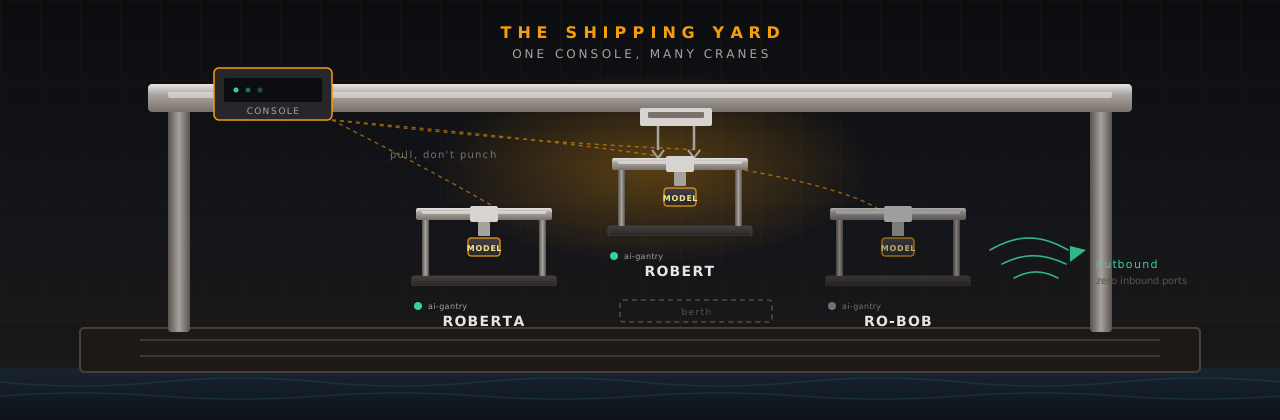
The yard
Operate named pets. Never sit in the turn.
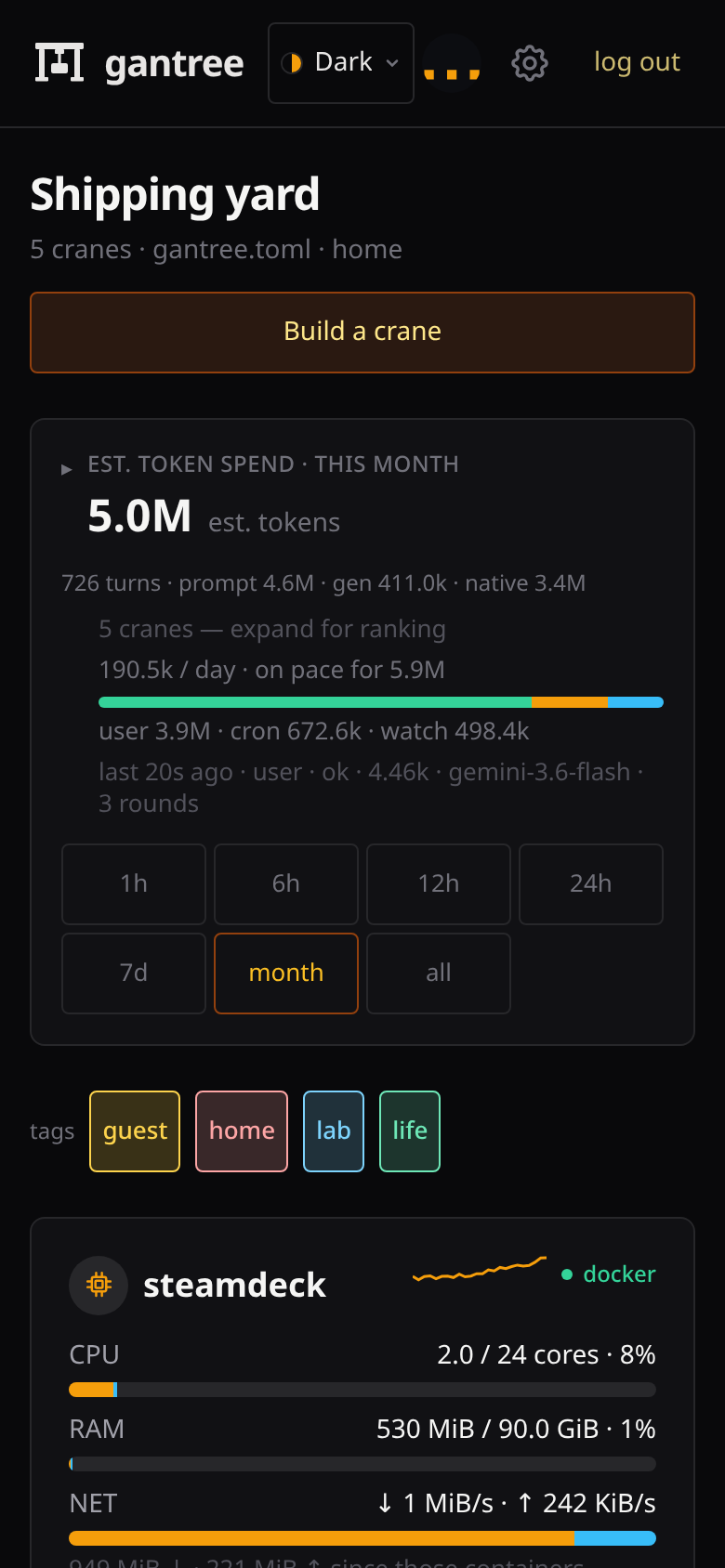
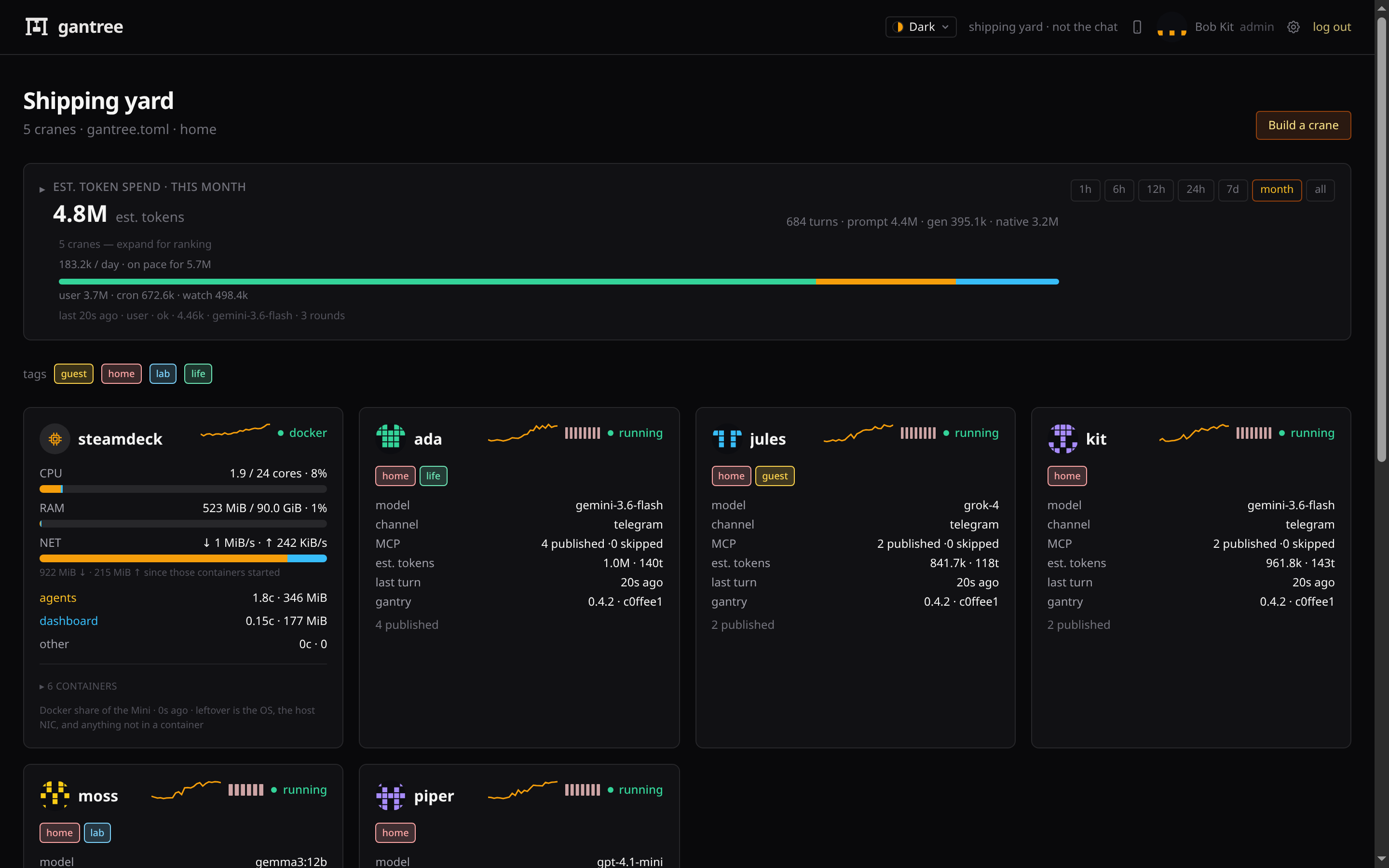
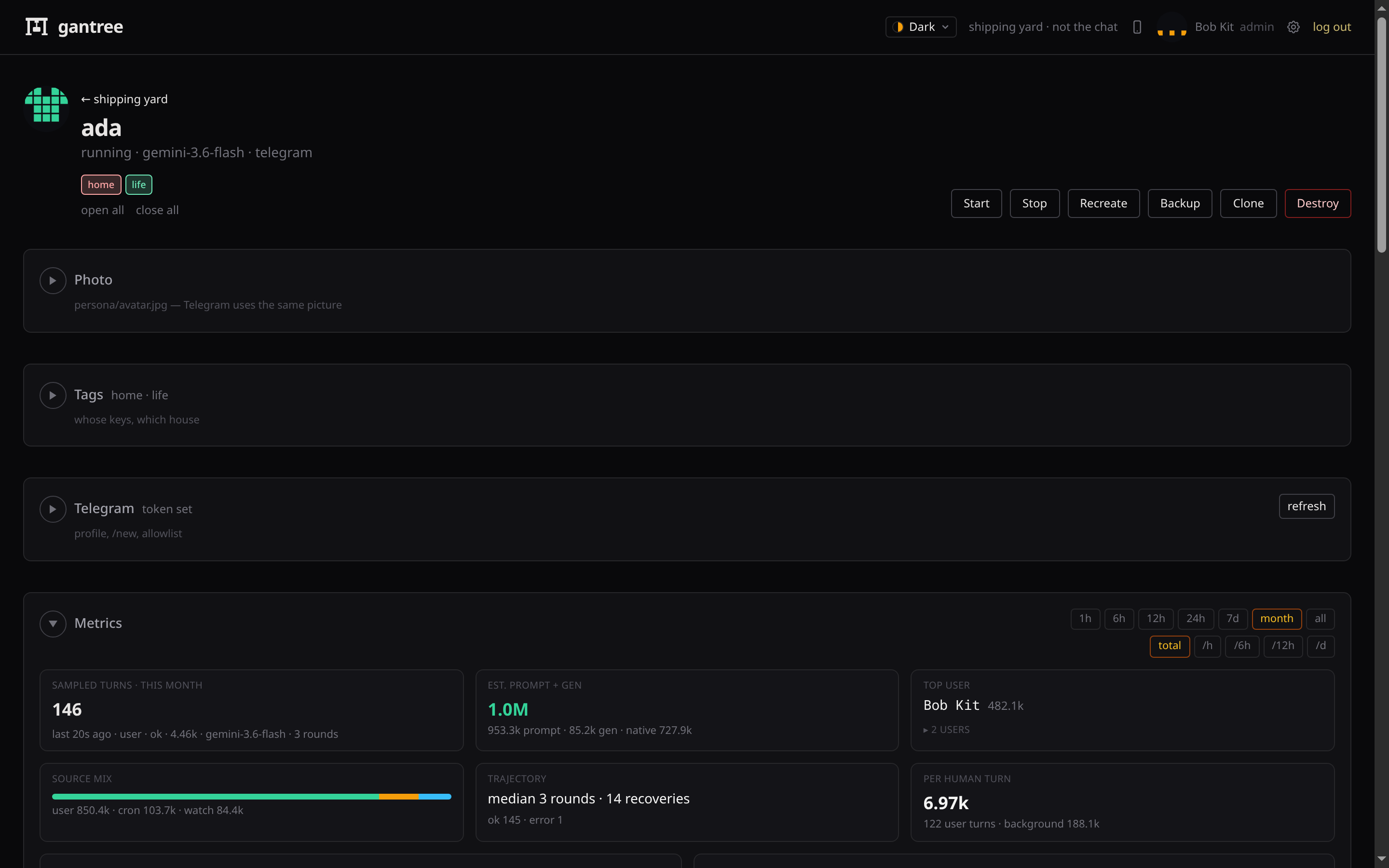
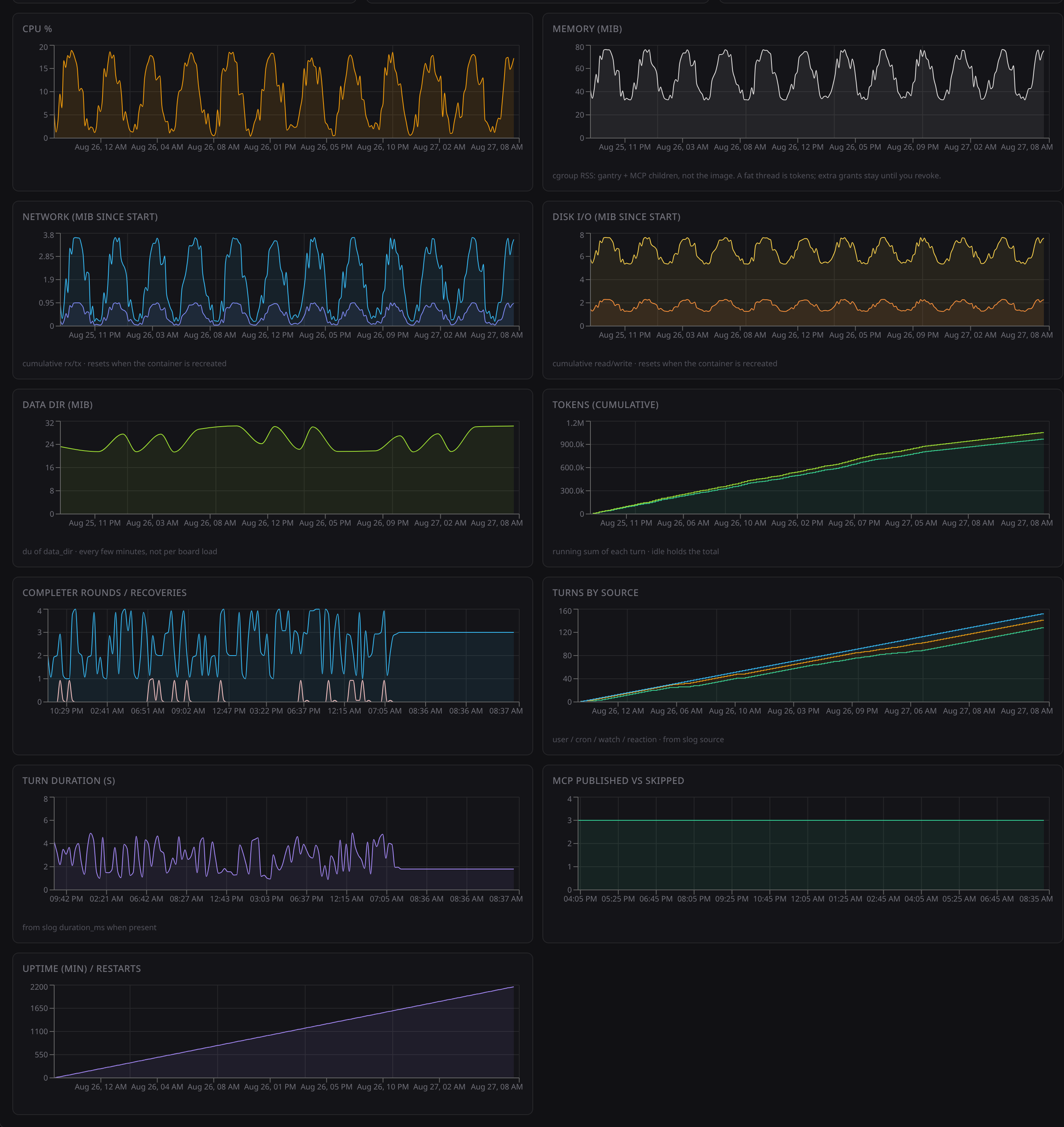
Gantree is the operator plane: board, doctor, grants, logs, spend. It
reads Docker and files after the fact. If a chart would make the
harness slower, the chart is wrong. Agents open zero inbound ports.
Only this UI is reachable, and only through a path you chose.
Hello
Docker on the same Linux host. Node 22. First boot is /setup.
git clone https://github.com/shotah/gantree.git
cd gantree
cp gantree.toml.example gantree.toml
npm install
npm run build
npm start                 # http://127.0.0.1:3000
Open the board. Settings → Pendant. Build a crane. Grant a tool.
Message it from the browser, from Cab, or from Helm. The UI never sits
in a chat turn. You do not need the other checkouts to stand a crane
up — this yard pulls shotah/ai-gantry, writes the files,
recreates. Home Mini vs cloud VM:
install.
Start here
The board, the door, the mouths.
InstallHome Mini or cloud VM. Same console. Zero inbound agent ports.
ConsoleBoard, grants, doctor, avatars. Default channel is pendant.
OperatorsSetup, login, profile, roles on a handful of people.
HeadlessAttach existing dirs, tunnels, the gotchas.
ArchitectureWhy Vinext on the Docker host, and why the yard pulls.
AccessOne person across yard, pendant, and crane.
SecurityThe door: bind, passphrases, sessions. Not a reason to open WAN 3000.
ai-gantryThe harness. Design, persona, MCP, the loop.
gantry-pendantMailbox and React web app. Open it anywhere. One room per crane.
gantry-cabAndroid app. Pocket thread and Android Auto on that mailbox.
gantry-helmiPhone app. Pocket thread and CarPlay on that same room.
EcosystemHow the wires and the doors line up, from the crane’s side.
 gantree